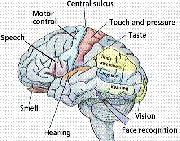
This course considers neurological, psychological, and structural models of intelligence. It uses these models as a basis for discussion and development of new models that may exhibit potential for creating embodied intelligence. The majority of biological intelligence creatures are simple, yet they can achieve complex information processing and computational tasks that current artificial intelligence cannot match. Can we use these simple models to learn how to design better artificial intelligence? Thus this course is a combination in the exercise of what we know about intelligence with discovery what makes its possible.
This course discusses advanced concepts of self-organizing networks of sparsely connected processing components (neurons and minicolumns). Neural-net implementations of pattern recognition algorithms provide important, practical advantages by allowing fast realization of parallel, iterative procedures. Self-organizing neural networks will be developed to implement associative spatio-temporal memories, statistical self-organization and learning, goal creation and goal oriented development of the memory structures. An example self-organizing neural system simulating biological systems will be examined.
The emphasis in this course is on development of the concept of self-organizing, learning neural system with locally interconnected processing components. Students will simulate neural networks for patter recognition and classification using PC software tools. This course will prepare you to study computational principles and hardware organization of intelligence, learning and goal oriented behavior. How to motivate a machine to act on its own, yet to satisfy a useful objective? How the machine's interaction with its environment leads to better behavior, better understanding, and success in its mission? What are the computational and hardware issues in doing this efficiently and in real-time? We try to define what it means to be intelligent, anticipate, learn from experience, make associations, perceive, act independently, self evaluate and think.